I like my coffee black as coal. I want no part of it if one can confuse it for tea. It’s only right that I’d eventually reach the heart of Pennsylvania’s anthracite country looking for a strong cup of coffee. A little background: Pennsylvania’s coal-mining country lies well northeast of the capital in the branch of the Appalachians spreading inexorably into New York. Anthracite coal is known as the most carbon-rich and clean-burning form of coal, and it’s been Pennsylvania’s trademark for centuries. This has resulted in an amazing number of ‘boom towns’ having emerged over the years nestled in the valleys and ‘hollers.’
I might have said this is Pennsylvania’s former coal-mining country, but that wouldn’t be accurate. As of 2022, Pennsylvania produced 2,357 short tons of anthracite and 37,345 short tons of bituminous coal (most of the latter being mined from the southwest region of the state. The coal industry isn’t what it once was in this state. Most of the forested mountains in Pennsylvania state were denuded of trees in the process of mining them in the 1700s. Thankfully that disaster is over. In its wake is a region being slowly retaken by nature as populations fall. Even so, beautiful small towns persist here.
Mount Carmel, situated in eastern Northumberland County, is one of the most iconic of these towns. Like coffee, the borough fills the ‘cup’ of the mountain fold it sits within from ridge to ridge. Towns tend to spread organically in the valleys, but Mount Carmel is a tight grid of buildings that includes two discernable ‘main streets.’ The area was settled in 1770, but Mount Carmel didn’t become an incorporated township until 1854 and wouldn’t be a borough for eight more years. Coal was the reason for settlement, so in many cases, the mines came long before the towns did.
This town embodies the friction between the past and the future in Pennsylvania. It’s rich in history and people, but unfortunately, much of that population is leaving for supposedly greener pastures. From a height of about 18,000 people in 1930, today’s population is less than a third of that. Even so, civic pride waxes high here, and I discovered hotbeds of local activity; individuals keeping the flame of culture burning in the heart of coal country. I came with the express purpose of visiting one that’s existed for 27 years: Cinnamon Stix Coffee and Gift Shop.
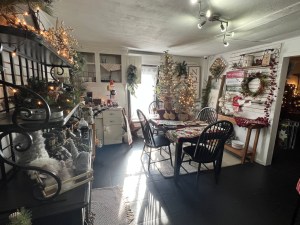
OK, first of all: This place is Christmas incarnate. When I heard the phrase ‘gift shop’ attached, I expected tchotchkes. Nothing prepared me for the sheer number of gifts available for sale here. As it turned out, the first floor was only the beginning. I went upstairs through a narrow stairwell, the woman at the counter had told me there were places to sit and hang out. That was quite an understatement.
Each upstairs room contained a different set of odd delights. A different delightful setting, I should say. ‘Delightful’ isn’t a word I use lightly, especially as a fortysomething guy. It’s gotta mean something if a guy with an unkempt red beard goes and says it. Seriously, there were more ways to relax than I have ever seen in a coffeehouse. One room was a Christmas wonderland. Another had what looked like an old English tea table. Yet another had a streamlined, modern setup. There was even a pink bedroom. Yes, it was open to the public. I didn’t stay long, though, eager to head back downstairs to explore the rest of the town. But first, let’s talk about the coffee.
The beans came courtesy of Basin Coffee Co. in Danville. Danville is a town to the northwest of Mount Carmel and it’s home to several coffee roasters if Google Maps is to be believed. Clearly, I’ll have to investigate further. I got a nice medium Columbian roast. The freshness was the standout characteristic here. Here was a case where the local nature of the roast manifested immediately. It was nice and mellow, with well-balanced acids. The structure existed (I would say) because the beans weren’t too aged. It’s the same in most cases. This is why it’s good to source locally, and there seems to be a real network of local roasters here in coal country, similar to the Amish roasters you’ll find elsewhere in rural PA.
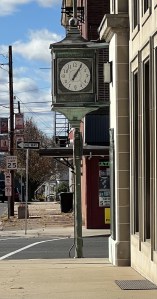
With coffee in hand, I set out to explore the rest of the town. One thing became immediately obvious: This is a close-knit community. Everyone at the lunch joint I went to seemed to know each other. Events were advertised on shop windows. I stopped at the library. Outside were free books, one of which I snapped up. Children played inside. A woman at the counter lamented that nobody comes in except to use children’s services and how members of former clubs are passing away. The library itself was beautiful and the staff cared. I wanted everyone else to care that much.
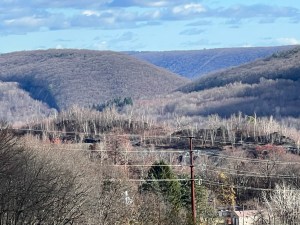
Vibrancy, however, clearly remained in the form of a fantastic bookstore called Secondhand Rows. This place was paradise for book nerds. Books were stacked haphazardly (which is how I stack them at home). It seemed there was a book for every topic, even a selection of witchcraft-related tomes, likely for Halloween. After resisting the urge to shop, I headed back up the mountain that would eventually lead me home. In fact, I didn’t take the direct route home, but that tale will have to wait for next week.
This was only Part One of the Anthracite Tour. Thanks to my penchant for taking the long way to anywhere, I found even more coffee on the way home. In this instance, I came down to Route 81 through twists and turns through the mountains and gaps between them. Until then, stay caffeinated!

the road in…

the road out…

the sign…
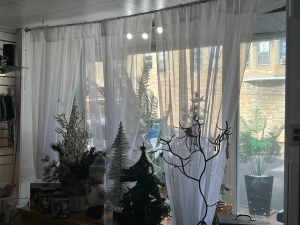
the season…
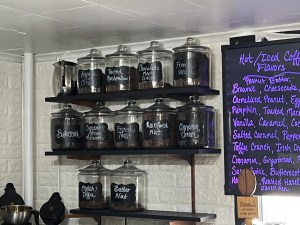
the coffee…
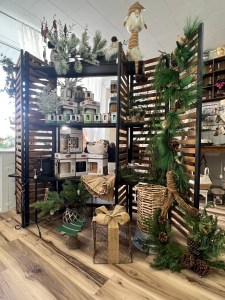
the gifts…
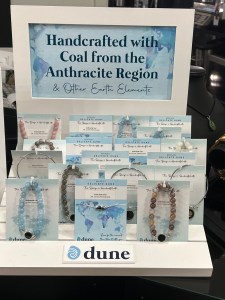
the coal…

upstairs…
also upstairs…

the melody…

the friend…
the time…

the bookstore…
the long road home…
 The Coffeehouse Journey