This has been a long time coming. I’ve been teasing for some months that we’d be taking this Journey into the Pennsylvania Wilds, and here we are: Williamsport, PA, the unofficial capital of the Wilds region. As much as Pittsburgh is often termed the ‘Paris’ of Appalachia, the city of Williamsport truly stands on its own amidst the grandeur of one of Appalachia’s least-tamed regions.
The Wilds takes up 25% of Pennsylvania’s land area but contains a mere 4% of its population. Even that figure is deceptive. Much of the population is concentrated in a few small areas of the Wilds, such as Williamsport and the string of large towns clinging to the West Branch of the Susquehanna River, separated from one another by its tributaries. Lycoming County is Pennsylvania’s largest county, housing over 110,000 people. That’s far less than half the population of Dauphin County (containing the capital), which is less than half its size. Here’s another telling figure: The Wilds is home to 2.1 million acres of forest and counting.
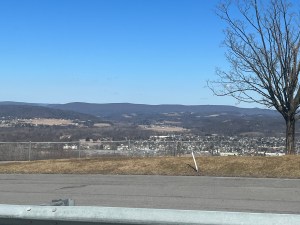
To get to Williamsport from Allenwood (which we visited in our last segment), simply head north over the mountains. They were still brown when they filled the windshield of our car on its approach to the final pass to Williamsport, but they looked no less alive for that. State game lands, farms, and many things bearing the name “White Deer” fill the valley immediately south of the ridgelines (which were unnamed, as far as I could tell…though if you know their names, please fill me in). Just north of the ridges is the sprawling cityscape of Williamsport. As one crests the ridge, there’s a pulloff spot ideal for looking down on the skyline, nestled against the broad, gray-green waters of the Susquehanna River.
Make no mistake, this is a ‘real’ city in the sense that Baltimore or Seattle are, albeit smaller. Williamsport houses less than 30,000 people, but this figure marks it as the largest settlement in the Wilds and the second largest in the PA Appalachians (after Altoona to the west). It doesn’t look like much until you get across the river, but when you do, immediately you’re confronted with the surprisingly tall buildings of a dense and bustling downtown.
Parking was surprisingly easy to find (and cheap compared to Harrisburg parking). Here’s where I should mention that my mom bravely drove us. Don’t worry. I compensated her in coffee. We’re both caffeine fiends, and neither had been here for years. Far more of the traffic was on its feet than on its wheels. Curio shops mingled with official government buildings set along tree-lined streets. Williamsport is walkable, in other words. I hadn’t expected that, given the size of the city.
Alabaster Coffee had been recommended to me by some Amish coffee makers far to the west. That happened several years ago, but it has taken me until now to wind my way this far to the north. I’m kicking myself for the delay. Although Alabaster is a significant coffee roaster up here, with several locations, the flagship shop truly stands out. Remember how I said Williamsport was a true city and not just a large but diffuse village like many other Pennsylvania locations? That’s on full display here.
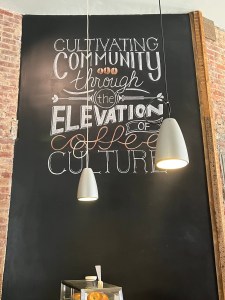
The coffee shop is spacious and elegant. It’s not just elegant; there’s a specific type of sophistication here which leaves the impression that the space was constructed as a destination. The apportionments (like the seating) are artistically rendered in hardwood and spotlessly clean. The old coffee roaster was displayed in an adjacent room. ‘Presentation.’ That’s the word I was looking for. It carries a sense of care for aesthetics that can typically only be found in an urban setting. Oh, you can find beauty in a rural location. Crafts in a rural home can be beautiful in ways that deliberate design can never be. Nonetheless, it was a curated design on display at Alabaster, and curated with a deft hand.
The coffee was produced at the level one would expect from a professional roaster. One of my favorite qualities was displayed: savoriness. That shouldn’t be surprising since this brew was South American. What I remember most fondly from this blend was balance. That’s what stayed with me. An almost vegetal almond note seemed evident to me, and although there was some heft to it, there wasn’t much earthiness, just that airy, wispy freshness characteristic of very fresh roasts.
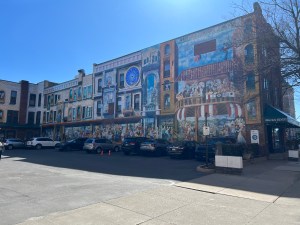
After coffee, we went down the street to a brewery called Bullfrog. The walk was as refreshing as the beer. Below, there’s a photo of a stunning mural painted on the sides of several adjacent buildings. That’s the urbanity I was mentioning before. In a way, Williamsport reminds me of a very large Carlisle. Like Carlisle, there’s a serious arts scene and an upsurge in civic pride. The ‘city’ feel isn’t a result of population, but of that pride. Wherever artists and artisans concentrate, you’ll get the beautiful heterogeneity that makes a place truly metropolitan. Since this isn’t a beer blog, I forewent adding pics of the brewery, but if there are any requests for them, I’ll gladly add them. I might do so anyhow at some point in the future.
Speaking of the future, the tour of The Wilds is not over yet. To get a representative sample of the land and the culture, I want to visit Center County (split in half into wilderness and Penn State halves) and fundamentally rural Clearfield County. Look for that sometime in April. After that, there’s no focus until we return to The Wilds in a few months. Prepare to visit wildly divergent coffeehouses as we journey through the Maryland and Pennsylvania festival scene. But first, the rest of the Wilds. Until then, stay caffeinated.

the beginning…
the city…

the downtown…

the ambience…

the merch…

the woodwork…

the old roaster…
the culture…
the art of a city…
 The Coffeehouse Journey