I don’t even know how to begin this post. It’s been a long time coming. For months, I’ve been promising a deep delve into the Pennsylvania Wilds, and for months of inclement weather and other sidetracks, I’ve been forced to delay. Now, at long last, we head deep into the woods on this Journey and visit the true backcountry of Pennsylvania.
If you tuned in about a month ago, you probably read about the trip to Williamsport, PA. Yes, that city is the showpiece of the Pennsylvania Wilds region, with a deep history and singular culture. It still doesn’t give a proper impression of what exactly the Pennsylvania Wilds region is all about culturally. Williamsport is cosmopolitan and industrial. It’s urban, and it’s hip. Much of the PA Wilds is none of those things. It’s removed from the bustle of that world. That’s the Wilds I had to embrace, and it will take two blogging segments to do so. Here we go.
Phillipsburg happened almost entirely by accident. I’d planned to visit here originally, but visiting became less likely as my plans took shape. First, it’s geographically close to my second target. Also, I wasn’t sure if this was just a catering business or a true coffeehouse. On a whim, I re-inserted Phillipsburg into the itinerary. That was the best decision I could have made.
This town doesn’t look like much on a map. It’s located in the Wilds portion of Center County, roughly encompassing everything north and west of the Black Moshannon State Park and multiple game lands along a wide, rough ridge of highlands. That ridge separates the manic development of Happy Valley (home to Penn State University’s flagship campus and world-famous Beaver Stadium) from the true wilderness of the Appalachian Plateau. That’s an important point: Beyond Happy Valley, the ridge-and-valley system of the Appalachian Mountains’ folds and the Alleghenies to the south gives way to the high, rambling terrain of the Plateau.
As we drove in (my Mom drove me up here, which definitely earned her a coffee), I was struck by how self-contained Phillipsburg was. It was very…town-ish. A lot of towns here are blink-and-you-missed-it villages spread out amidst farms in a lowland between forested mountains. We’ll visit one of them soon. Phillipsburg was not this. Old stone buildings and a well-defined downtown made it look like a mini Carlisle (much as Williamsport looked like a big Carlisle). A railroad ran through massive edifices, and construction workers labored away on the street. As it would happen, a whole crew was tearing up the street adjacent to the coffeehouse. That’s when the cursing started.
I had no idea how we should even begin to get past them to the coffeehouse. It was 11:45 AM. The Brown Dog closes at noon most weekdays. After shouting a few expletives, my very calm mother parked the car, activated the blinkers, and I tore up the road to the cafe. Some construction workers personally vouched for our questionable parking action. I thanked them and kept running. I was assured that (ahem) makeshift parking actions were the norm in Phillipsburg.
I arrived just in the nick of time. A lone neon sign (a dog, ironically blue, not brown) hung above a drab stone front. There was nobody else in the shop besides the barista. I breathlessly explained my mission to her, and this sweet lady enthusiastically told me the story of Brown Dog. Technically, the full name is “Brown Dog Catering, Coco’s Coffee House-The Kitchen @ Brown Dog.” The name has an interesting story:
This operation began in 2017 as a catering business, providing coffee and such on request at pop-up events. Then, in 2020, a fire devastated the business. From the ashes arose this beautiful coffee shop. Seriously, look at the photos below. Inside are walls of memorabilia and rows of elegant tables. I couldn’t describe many coffeehouses I’ve visited as ‘elegant’ in the classical sense. Hip, definitely, but not traditionally graceful. This coffeehouse is. It looks more suited to high tea than Bohemia. There’s a reason for that.
There are dinners here. Fancy ones, by all accounts. The woman who greeted me, Erica, explained that beautiful dinners of 8 to 12 courses take place in the spacious dining room, offset slightly from the coffeehouse portion. That’s not all. They also have a vast array of pastries and similar fare for casual dining for people who just want to sit and people-watch through the windows. In a way, the coffee seems almost secondary to the main focus: food and bringing people together over food. On second thought, I can’t call the coffee secondary because great care was taken to source it.
The coffee came courtesy of Standing Stone Coffee Company of nearby Huntingdon. That’s in the Alleghenies. Remember how that was the town other than Altoona we didn’t get to during the Alleghenies portion of the tour? Well, now we have, in a way. Standing Stone prepares professionally curated blends for coffeehouses like this one. Everything is personalized and proprietary; I wasn’t even told what the blend was. I got their Coco’s House Blend, which was clearly some kind of South American mix. Watch, the makers will comment in the comments section that I’m totally wrong. That would be fun, actually.
Anyhow, it was immediately obvious that the Standing Stone people are experts. I found strong, flowery, fragrant notes with a bit of berry, layered atop a mellow acidity. There was the creaminess that normally characterizes South Americans, which is why I’d be willing to wager that such beans are at the very least a major component of whatever they were doing here.
Brown Dog was pure urban sophistication at its best…and I found it in the wilderness. Or maybe, sophistication is universal, and it’s to be found anywhere you can find it. I think that’s the takeaway. An appreciation for the finer things suffused the very bones of this cafe. An appreciation for art leads to connoisseurship in a slippery slope of the best sort. They closed minutes after I left, but I’ll certainly be keeping an eye on them from distant Harrisburg. For now, it’s time to go deeper into the countryside.
Our next stop is to the north, just to the south of the village of Kylerstown. It’s in the adjacent county of Clearfield, but it felt like a hundred miles away. Stay tuned for the last chapter of the Wilds portion of the Journey soon. Until then, stay caffeinated.
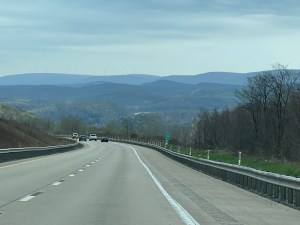
the road into the wilds…
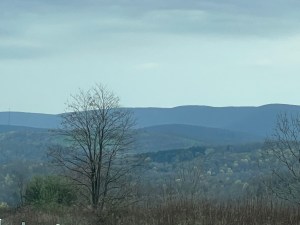
the wilds…

the park near phillipsburg…
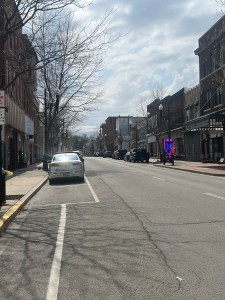
the downtown…

the blue dog of the brown dog…
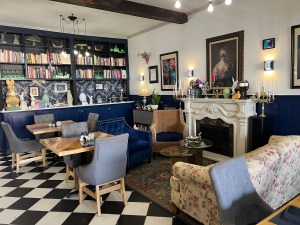
the setting…

the tables…

the roast…

the rest…
 The Coffeehouse Journey