RSS

Monthly Archives: September 2025

Stone Mill Cafe & Bakery, near Timonium, MD

I always have a backup plan. Whether I’m packing extra clothes in the trunk ‘just in case,’ or I’m stuffing extra precharged batteries in my pocket to stave off the consequences of a phone losing charge at exactly the wrong moment, I like to take a cue from Odysseus and never be at a loss. Sometimes, that looks like choosing a contingency coffee shop.

When I planned the trip to Cafe Luli, I wasn’t sure there was a Cafe Luli. The website hadn’t been updated, and Google Maps couldn’t produce their hours. I wanted to plunge that deep into the Baltimore countryside, but I didn’t want to waste gas if there was nothing there. I had to find a place that looked promising, but which wasn’t too far off the Beltway. That place was the Stone Mill Cafe and Bakery just outside Timonium.

The name alone sounded auspicious. Stone mills are where you make craft bread. They’re historic. The image of a stone mill easily dovetails with the thought of sitting by a window with a steaming cup of coffee and contemplating things. Assuming that was the intent, I screenshotted the directions and set off. Cut to a few hours later, the entire exercise was unnecessary. Cafe Luli was there, and it was fabulous. But that left me wondering: What about the other place? It was on my way home, and I couldn’t just do one coffeehouse when two on the same stretch of highway were viable options. So, I decided to stop by Stone Mill after all. I’m glad I did.

Oddly enough, this was yet another coffeehouse in a plaza. The plaza can’t possibly be new, since I’d learn that the Stone Mill Cafe has been here for over thirty years now. It sits along famous Falls Road, as does the plaza. Falls Road is a major thoroughfare in suburban Baltimore, connecting a multitude of similar shopping malls, service plazas, train stations, and hotels that cater to the thousands of travelers who pass through the region every day.

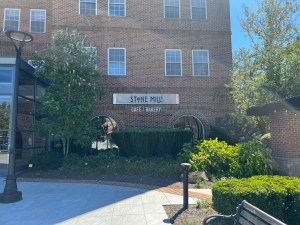
The Stone Mill, in this context, is something of an oasis. You’ll see what I mean if you look at the photos below. The building is trying its level best to be cozy, and it does as well as a tall brick edifice can. The garden and archway help. Oh, yes, there’s an arch leading through a green space strewn with seating; the path leads to the entrance of the coffeehouse proper.

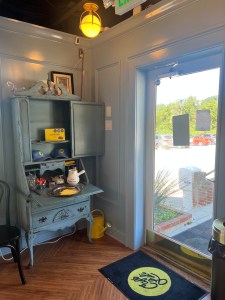
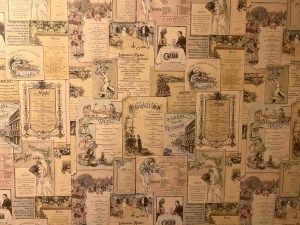
The interior was not at all what I had been expecting. I don’t even know what to call it. It was a hodgepodge of features. There were tables beneath fascinating works of art. There was a busy counter fit for mass coffee production. Then, I found a large, circular window looking out over the green space I’d just come from. Dreamlike. That’s the word I’m looking for. You know those dreams you can’t forget because they’re such a bewildering combination of images that they stay in your waking memory? That’s Stone Mill.

Regarding the coffee, my expectations had gone through a rollercoaster ride on the way here. First, I thought ‘Stone Mill’ meant something self-consciously fancy. Then, when I saw the plaza, I thought this might end up being some cheap, generic Arabica fit for travelers more thirsty than choosy. They defied me on both counts.

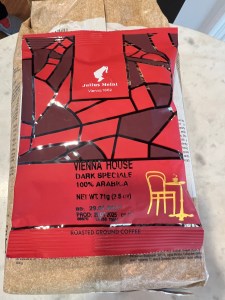
The coffee was from La Colombe, a roaster in Philadelphia. They’re famous for being a key member of coffee’s Third Wave. ‘Third Wave’ coffee is an academic term for what we’d call craft coffee. Specialty, boutique roasts only really burst into the Western mainstream during the latter days of the hippie era in the 1970s. For perspective, the First Wave includes diner coffees. The Second Wave emerged in the heyday of the cultural revolution in the 1960s, with a focus on spotlighting its international sources. La Colombe wasn’t founded until 1994, but it was the 90s (far more than the 70s) that are associated with what we consider ‘coffeehouse culture’ today.

I didn’t really get a coffee. I got a soup. That’s how strong the coffee they gave me was, and indeed, they’re proud of having the strongest coffee in the area. It immediately reminded me of something I’d had a few months ago: Turkish coffee. Turkish coffee is known for being so thick that you have to wade through the grains at the bottom of your always-tiny cup. Stone Mill wasn’t making it quite that thick, but the flavor profile was so deep it was almost smoky. It was also intricate, with a distinct green pepper note spicing up the rich, leguminous base.

I love pleasant surprises. Alright, we all do, but this one came after driving through the Maryland woods all morning, so it gets bonus points.

As I write this, I’m planning what region to showcase next. I’m also praying for more rain to help the last vestiges of my garden last a few more weeks into autumn. Please join me in both endeavors. Here’s the travel dilemma: I was originally considering a jaunt to Delaware, but a trip northeast amended that plan. There are too many interesting small towns up there to ignore. We’re headed back through coal country, the Bloomsburg area, and hopefully on to the Poconos! I’m an Office fan, so don’t be shocked if the Journey winds its way up to Scranton and into that…well, you know, that New Jersey/New York, Parsippany-type place. Oh, I have no clue what to call that region. Help me out here, people. Anyhow, that’s where the Journey’s aiming for next.

Until next time, stay caffeinated!
the facade…

the grand entrance…

the setup…

the art…

the whimsy…
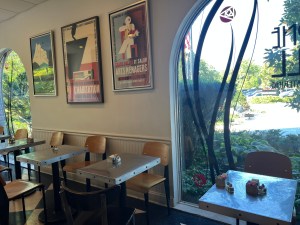
the seating…
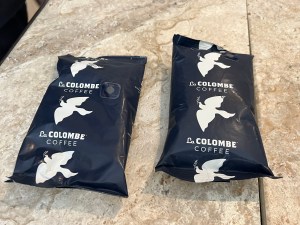
the beans…

the data…
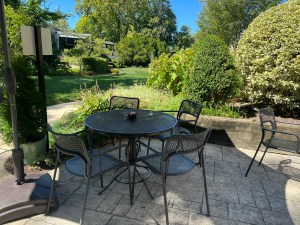
the great outdoors…


3 Comments

Posted by on September 19, 2025 in Uncategorized


Cafe Luli, Stevenson, Maryland

Beep. Beep. Beep. That’s the sound I heard about a week and a half ago outside my window at 6:53 AM, heralding the beginning of a construction project. A new set of sidewalks is being installed across from our house. As of the time of this writing, the worst of the drilling appears to be over…for now. Bear in mind that two weeks ago, Fort Indiantown Gap did live fire exercises for a few days at a time. They didn’t start their work until 8:00 AM, so it wouldn’t disturb people. Just some food for thought.

Thankfully, the people doing the cement pouring were kind enough to delay making noise as long as possible, even though their work order apparently required them to be there shortly after 6:00 AM. It’s also not every day, which is a blessing (or perhaps an act of mercy on their part). We still don’t know how long it will take to finish the project, and I’m left stewing over the fact that the one place I go to hide from the rest of the world is under siege by it. That’s a bad feeling. I needed a good feeling.

That good feeling came when I ran off to Maryland. It was warm. It was Saturday, and on Labor Day weekend, no less. The morning had been blissfully silent. One issue: My car was low on oil. I didn’t let it dissuade me. I jetted off to the nearest auto body shop, grabbed some 5W-30 oil, and set off down Interstate 83 towards Baltimore. I’m glad I did.

OK, I wasn’t actually going to Baltimore. I’ve been doing a coffee tour of suburban Baltimore and the surrounding countryside. If you remember, we’d just visited outer Towson when a local coffeehouse interrupted the process by springing up east of Harrisburg. Google Maps revealed something I hadn’t noticed before: a small, very French-looking cafe sitting in the countryside north of Pikesville (a suburb of Baltimore known for its Jewish community and endless lunch spots).

Info about Cafe Luli is scant and contradictory online. One page says they’re coming soon; another says they’re already here, and the social media sites haven’t been updated in a spell. There was no phone number, either. I was concerned that once again, a promising cafe had opened and closed before it could gain a following. As a matter of fact, I had a contingency coffeehouse standing by on my itinerary in case this one no longer existed. We’ll get to that later.

Cafe Luli does exist. It exists, and it exceeded expectations. It’s located in a plaza, and I’ve had mixed experiences with coffeehouses in plazas. They tend to be commercialized more often than not, and the traffic absolutely obliterates the coziness one expects from a coffeehouse. That wasn’t a problem here because Cafe Luli is nestled in a little alcove near a golf course, separated from the Baltimore beltway by a few dense little woodlands and more than a few upper-class residences.

I couldn’t find a town of Stevenson, per se. It was more of a collection of homes. It is home to Stevenson University. It was once known as Villa Julie College. I had received a letter from them once, back when I was just about to graduate high school, and the brochures started coming in. There was no time to visit. The coffeehouse was going to close at 3 PM, and it was already 2:15.

The cafe looks super European. I love that. I like homages to Old World culture. There’s a little restaurant in Harrisburg called Au Bon Lieu that replicates a Parisian cafe. Cafe Luli does the same. It doesn’t go overboard, though. There are nods to France, but with a minimum of kitsch. The relative smallness of the space is more than made up for with a lovely, intimate set of tables in a second-floor area. Even here, the decor is minimal. The accoutrements you see in the photos below were on the bathroom and stairwell walls.

The coffee hailed from an unexpected locale: Austria. Julius Meinl is the name, and it’s been in operation since the mid-19th century. Now, that’s provenance! At that point, I was grinning with victory over the fact that this place turned out to be open despite all odds. It’s not just open; it’s thriving. I asked for the closest thing to a typical house blend. What I received was hard to place. Oh, it was expertly crafted, of that there’s no doubt. This roaster is no fly-by-night operation. What I mean is that the blend was so…blended that it was hard to tell where the beans might have originated. There was a mild earthiness and chocolate-ish hints, but they were something of a background. A slight leguminous quality was also there. The real kicker was the light whisper of citrus on the end, which wasn’t enough to connote an African origin for some of the beans, only to tease a vague possibility. I’d bet there’s Sumatran DNA in this roast. The robust body alone speaks to it. The coffee was called Danube Delight, but beyond that, the contents were a mystery.

I spoke to a rather brilliant coffee lover on the staff (I believe her name is Kay, but I’m horrible with hearing names, remembering names, remembering faces, or recalling general short-term and long-term events). She and I kibitzed about the flavor of this particular roast for a while. We both agreed that it would be wonderful to taste European-grown coffee and lamented the impossibility of growing beans in Europe. We also concurred that our ‘medium dark’ is ‘dark’ to most other people. Coffee aficionados (meaning the coffee-obsessed, if we’re being honest) tend to think alike.

Cafe Luli was not the end of the Old World charm present in this plaza! There was a wine shop called The French Paradox right next door. They were having a tasting that afternoon. Having gotten my uppers, I resolved to partake of some downers and sampled five Rhone wines. After letting the wine wind its way through the old liver, I departed for my next stop: the backup coffeehouse. That exceeded my assumptions as well, despite its location in a (you guessed it) plaza.

It’s interesting, isn’t it? We’ve seen many instances of a coffeehouse in a rural or quasi-rural setting adopting a modernistic aesthetic while leaning into rural customs and cultural conceits. At Cafe Luli, the opposite is happening. Here, we see an extrusion of something quintessentially urban into the fringe. In our society, all things French have long been a code for sophistication. I’d say the association is well-deserved. Austria deserves it, too. I’ve spoken at length regarding the Enlightenment and the debt it owes to coffeehouse culture. Paris and Vienna were hotbeds of a cosmopolitan worldview that would help evolve the collective consciousness of humanity. Those heady philosophies were digested and debated around mugs of coffee. Revolutions were brewing. A bit of that heritage now sits across the road from the first rolling farms of the rural Maryland countryside.

Oh, and I learned something else: This cafe has only been around for a short time. It was planted just after Easter. It’s less than a year old. That’s a stark reminder of how unstoppable coffeehouse culture is. Our troubles may change. Our needs remain the same. For a lot of us, one of those needs is an exceptional cup of coffee.

Until next time, stay caffeinated!


the front door…

the cafe…

the bric-a-brac…

the upstairs…

the wall…

the beans…

more beans…

more details…

the old machine…

the thoughts…


Leave a comment

Posted by on September 4, 2025 in Uncategorized