It’s funny, whenever I send a link to this blog to a prospective employer as a sample of my work, it rarely bodes well. There are no negative comments. There aren’t any comments at all, nor responses to my humble interview requests. My writing style isn’t conversational. I don’t write the way people talk because people write the way they think, and I don’t think the way many people do. I imagine that most professional writers would find this blog somewhat childish. I hope so.
I feel thirty years evaporate when I hit the road.
I need to remember that. Maybe then, I’ll drive off into the countryside more often. If I do that, you’ll learn about more coffee, and so will I. In my defense, road trips are becoming increasingly challenging as autumn gives way to winter. Already, the ridgelines in northeastern Pennsylvania are capped with snow. A few thousand feet of extra elevation makes all the difference this time of year. Northeast PA (NEPA) is exactly where we’re heading on this leg of the Journey.
This entire adventure will be divided into two parts because I visited two distinct towns on the same trip through the mountains. Those mountains are a huge part of the draw, the story, and the history of this region of Pennsylvania. NEPA is just to the north of the Coal Region we visited before. It’s a continuation of the same belts of terrain, though, and the entire Anthracite region of Pennsylvania shares a stratum. Rocks here date mostly from Carboniferous times. From 350 to 300 million years ago, this area was home to dense rainforests that would transform into the coal we mine.
I should have said “mined.” The coal days are largely in the past, and this area is reinventing itself rapidly following a long period of middling survival and gradual decline. What remains are reminders of that past and hints of a transformative future. The Poconos are a great example of prosperity in northeast Pennsylvania, but the town of Bloomsburg is emblematic of small-town Pennsylvania’s embrace of change.
The sprawling town of Bloomsburg is notably home to Bloomsburg University. Called “Commonwealth University-Bloomsburg” since the year 2022, when it merged with Lock Haven University and Mansfield University, the institution has a history dating back to 1839, when it was known as Bloomsburg Academy. Since then, the name has undergone several changes, but the goal of education has been the same. That mission is written all over the town.
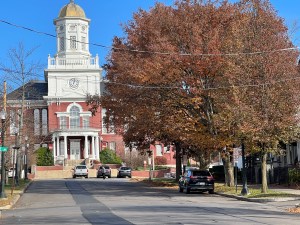
Walking down the main street, the horizon curves upwards to the front of Carver Hall. Flanked by trees with flame-colored autumn leaves, it’s archetypally collegiate. Student housing is advertised along Main Street, a bustling avenue lined with shops clearly catering to students. A library, theater, and post office are arranged in a line, as is a bevy of restaurants, pubs, and coffee shops. One of those establishments is Martha’s Cafe.
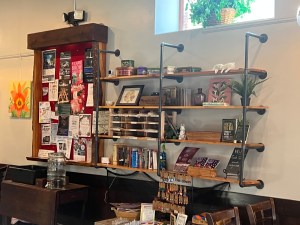
The coffee shop was known as Fog and Flame for over a decade until January of this year. That’s what Google Maps still calls it, as do the slowly fading letters above the large, beckoning windows. “Beckoning” may sound like florid prose, but take a look at the photo below. Now, imagine yourself as a student, not just falling in love with academia, but suffused with it. If you could see my bedroom and its ring of bookshelves, you’d know I didn’t have to imagine what that feels like. I am that person. Martha’s is very clearly engineered for people like me. From the bookshelf along the wall to the hardwood accents, it…Yeah, I’m sticking with “beckons.”
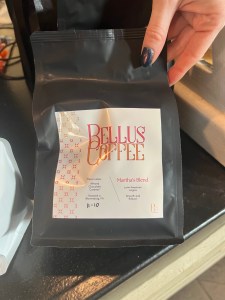
The coffee is locally roasted. Oh, yes, I’m getting right down to brass tacks. The coffee gets an immediate shout-out for being a local brew. Bellus Coffee is roasted in Bloomsburg. If you haven’t heard of it, that’s because it’s specifically a small-batch specialty roaster. Boy, are they serious! Listen to this quote from their website:
“Bellus” comes from Latin roots meaning “beautiful” or “to do”. It is our firm belief that we are not meant to sit idle but to act with faith to be a part of something beautiful.
You know someone’s serious when they get philosophical. Describing what good and bad coffee tastes like on that same first page was a bold move, but it signalled a large measure of passion on their part. Really, though, half of the taste is in the preparation. The roaster has to be skilled, but so does the brewer. In the case of Martha’s, both “ends” of the coffee process were on point.
“Martha’s Blend” was a Latin American mixture, specifically. Almond, chocolate, and caramel notes were all advertised, and they were there; still, the most prominent of these was the caramel, which manifested as a mouth-watering smoky hint at the end of a buttery smoothness born of balanced acidity that stood out. It’s sometimes hard to make rich coffee “drinkable” for casual imbibers; however, everyone involved here did a noteworthy job.
Here’s another interesting thing about Martha’s that’s also true of many other Bloomsburg operations: It reflects the intellectual current of academic culture as it stands now. A prominent Pride flag was displayed, along with more subtle “tells” of a postmodern, countercultural vibe. Though if it’s the prevailing culture of a place, is it still a counterculture? That conundrum deserves its own post; what’s important here is the mood of consensus among growing minds as they ask the big questions.
Throughout this blog, we’ve seen the urban institution of the coffeehouse assimilated by a prevailing rural culture. Here, we experience the opposite: a reiteration of urban intellectual cultural motifs in a setting that might not be accurately described as “rural” at this point in history. In other words, Bloomsburg is a college town, through and through.
On the topic of history, the last photo in the set provides a glimpse into the past I mentioned. On the way here, the road was closed to let a train chug past. It was brief, and it was certainly not hauling coal. There were passengers. They waved gleefully at the folks like me who got out of our cars to snap pictures of the passing. We waved back, like we would have when we were children, and all the little joys seemed magnified by the compressed years of so-far brief lives. Daring to still feel that way is a counterculture.
I imagine we’ll see more reminders of Pennsylvania’s past at nearby Danville. I made an unexpected stop there on the way back from Bloomsburg. In that post, I’ll tell you why. I’m not sure if Danville counts as NEPA. Less than ten miles from Bloomsburg, it feels like a transitional species between coal country and the Susquehanna River valleys. We’ll see what that unique region has to offer. I’ll be writing that entry in about a week.
Until then, stay caffeinated.
the college…

the heritage…

the town…

the cafe…

the ambience…

the art…
the stuff…
the roast…

the road in…

the train…
 The Coffeehouse Journey