Merry Christmas and Happy Holidays to all my caffeinated friends in cyberspace! It’s been a minute since I posted, but that’s because the holiday season was rather unrelenting. It was joyful, no doubt. The preparations and family gatherings were a veritable marathon, though, and the wind is raging outside as I type this. Thankfully, we take peace pretty seriously around here. I unplugged from electronics and cozied up at home with my parents and about a metric ton of my mom’s cooking. Turkey was had, tryptophan was absorbed into the bloodstream, and the outside world was shut out to the point where I’ve been having a hard time readjusting.
It’s the most liminal time of the year.
What do we even call these odd days between Christmas and New Year’s Day? I don’t think it matters. It’s enough that some days just exist. In fact, I needed a few days lost in the fog to figure out what I was going to write here. Travel was out of the question, but my folks came to the rescue with more than just food: They came bearing coffee. Granted, I more than hint to my mom that new coffees are always a good gift idea. It’s good to be a spoiled brat.
So, without further ado, here are this year’s coffee randos from across the world:
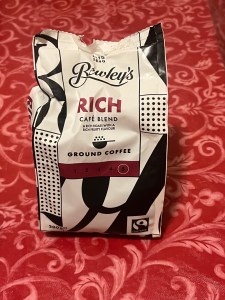
First up is Bewley’s Rich Cafe Blend. Something tells me I had a Bewley’s on here last Christmas. It might not have been the rich roast. I suspect it was the dark blend. If it were the rich roast I reviewed last time, I wouldn’t be sorry. I needed to follow up on this one. Bewley’s is a hot beverage company from Ireland established in 1840. With all that experience, you’d think they’d put together a good blend. They do. It is, however, quintessentially British in a few key ways.
The flavor is delicate, almost a whisper. The label says “rich,” but that needs to be taken in context. To me, it was similar to a breakfast blend I had not too long ago in Maryland. It was airy and light. That’s not to say it was threadbare. It wasn’t anything of the sort. The full range of deep flavors one would expect from a medium blend of beans was there. The balance was lovely. The palette was subdued. I had to shovel a few extra spoonfuls into the brewer to bring it up to strength. A travesty to the British, I’m sure, where subtlety is part of the art.
The bag is small, and, really, that’s my only complaint. For the amount I need to use per cup, I need more. Again, though, I think that’s a cultural difference, and my chronic overpouring would probably be seen as garish in the extreme.
Now for something completely different. Siena Arte coffee is (unsurprisingly) based in Siena, Italy. It’s a moderately well-known coffee company, best remembered for its espressos. I received their Napoli roast. I’m honestly not sure what that means. Even odder is the fact that the package reads “Origin: Non-EU.” OK, maybe they’re talking about the beans themselves. Obviously, they have to be sourced from outside the European Union.
Siena Arte was unexpectedly inexpensive. It’s imported, so I’d assumed that would increase the cost tremendously. It also looks fancy, as you can see below. It costs less than the equivalent amount of coffee from Dunkin’ Donuts. I’d wondered if that meant it was secretly Robusta. Robusta is normally used in the making of instant coffee. This didn’t taste like crystals. I forgot to mention, this is a whole-bean offering. It was difficult to even place the taste, except to relate it to a hefty Americano, which is diluted espresso. The bitter core and sharp acidity common to espresso-style coffee were immediately evident.
This was another coffee that I used massive amounts of to achieve a robust flavor. At least there was enough of it to do so! You know what this coffee is good for? Mixing it with another coffee to boost the raw power of a more refined roast. I’ll keep y’all apprised.

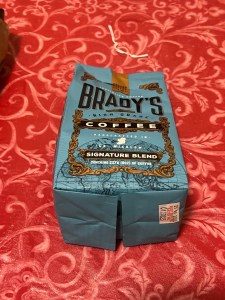
There are actually two Brady’s Coffees out there. One is in Tyler, Texas. The other is in Ireland. This is the Ireland one, and it turns everything I originally said about UK coffee on its head. I won’t equivocate here. This was my favorite of all four coffees I’ve sampled for this review. It was gorgeous. Alright, let’s back up for a second.
Brady’s Coffee is a newcomer to the otherwise venerable European coffee scene. It was founded in 2007 in County Wicklow as an artisan roasting company featuring barrel-aged coffee. A barrel-aged coffee is one in which the coffee beans (while still green, mind you) are left to sit for a few weeks in barrels that once contained whiskey or other spirits. Let me just say, that’s a fantastic idea. Old barrels add a bold, rich flavor to wine, and they do the same to coffee beans.
I’m not sure if that was specifically used on Brady’s Signature Blend. They were certainly slow-roasted by hand, and you could taste the care. Sure, Brady’s is a large company, but the artistry is still evident. The mouthfeel was liquid silk, the acidity was ideally balanced, and there was no astringency to speak of. As was the case with the first British coffee, I needed to use a little extra, but the result had a singular distinction. This is a new favorite.
Speaking of favorites, Zimmerman’s is one of my favorite companies. I reviewed a different coffee from them last year. At least, I think it was different. Both were “Rose Garden” coffees, but this one was a 100% pure Guatemalan, unlike the previous one. That featured a proprietary blend of (I think) South American beans.
Zimmerman’s is properly a candy shop. Their flagship store is only a few minutes from my house in the neighborhood of Penbrook, just east of Harrisburg, Pennsylvania. Penbrook used to be called East Harrisburg, but nowadays, it’s a borough of its own. Zimmerman’s has been around since 1915 and has barely changed. John Zimmerman started it. His grandson is continuing it. Stepping into the shop is an immersion in pure Americana.
This coffee was whole bean, and I did it a disservice by not grinding it long enough. It was the archetype of a Guatemalan coffee. There were deep chocolate notes all over the place, overlaid by a subtly leguminous series of flavors. That’s what I wanted when I deliberately picked up the Guatemalan. Once again, Zimmermans gave me exactly what I was looking for.

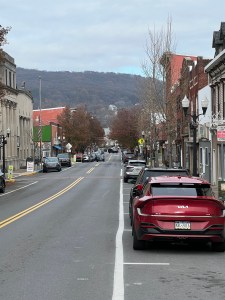
I’ll be on the road again soon. I mentioned the Poconos, and that’s still the goal, though the Journey might make a quick detour further to the northeast and take a look at what’s happening in the Wilkes-Barre/Scranton area these days. I want to get a good sampling of the Northeast PA (NEPA) region, and there’s way more to NEPA than the Poconos. That’ll be in about three weeks, weather permitting.
Until next time, stay caffeinated!


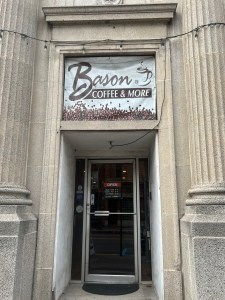


 The Coffeehouse Journey